
Presque Isle Court Records After Arrest
After a Presque Isle County jail arrest, the first public trail may be split between custody records and court records. The jail side confirms whether the person was booked, held, released, or still awaiting transport or bond. The court side starts when a complaint, ticket, warrant return, or other charging paper reaches the proper court. For most local criminal cases, that first court stage is the 89th District Court, which serves Presque Isle and Cheboygan Counties and handles arraignments, bond, misdemeanor cases, felony complaints, and felony preliminary examinations.
Booking information and filed charges are not the same record. A booking may list an arresting agency allegation, while court records show what the prosecutor authorized and what the judge did with the case. For the custody side of a fresh arrest, use Presque Isle County jail inmate records. For booking-photo issues, use the Presque Isle County jail mugshots material. Court records after a jail arrest should be read for filed charges, bond orders, hearing dates, warrants, charge status, and final disposition.
Arrest to Presque Isle Court Records
The local path is arrest, booking, District Court, prosecutor charging review, and then either District Court resolution or Circuit Court transfer. A person arrested by the sheriff, Rogers City Police, Michigan State Police, conservation officers, or another local agency may be taken to Presque Isle County Jail. Intake creates local custody paperwork, but the criminal court record takes shape after a complaint or other filing. The District Court page states that the court arraigns defendants, sets and accepts bond, issues misdemeanor complaints, issues felony complaints, and conducts preliminary hearings in felony cases.
The Presque Isle County Prosecuting Attorney is the charging office after law enforcement submits reports. The prosecutor decides whether to authorize charges, which charges to file, and whether to amend, reduce, or dismiss counts as the case develops. For felony arrests, District Court handles the early complaint, arraignment, bond, and preliminary examination. If probable cause is found, or if the preliminary examination is waived, the felony case moves to the 53rd Circuit Court for later felony proceedings.
Local flow: Arrest -> booking -> District Court arraignment and bond -> prosecutor charges -> preliminary examination or waiver -> Circuit Court after bindover for felonies.
Find Presque Isle Court Records
Use MiCOURT Case Search and the court-specific links from the Presque Isle County District Court and Circuit Court pages for public case lookup. If the case is too new, the person may have been booked but not yet indexed online. In that situation, confirm custody with the jail, then check the appropriate court clerk. District Court is the likely first call for recent misdemeanors, felony complaints, arraignment, and bond. Circuit Court is the better place for felony files after bindover or waiver.
The MiCOURT public case-search portal is shown in the captured source image used for this county research.
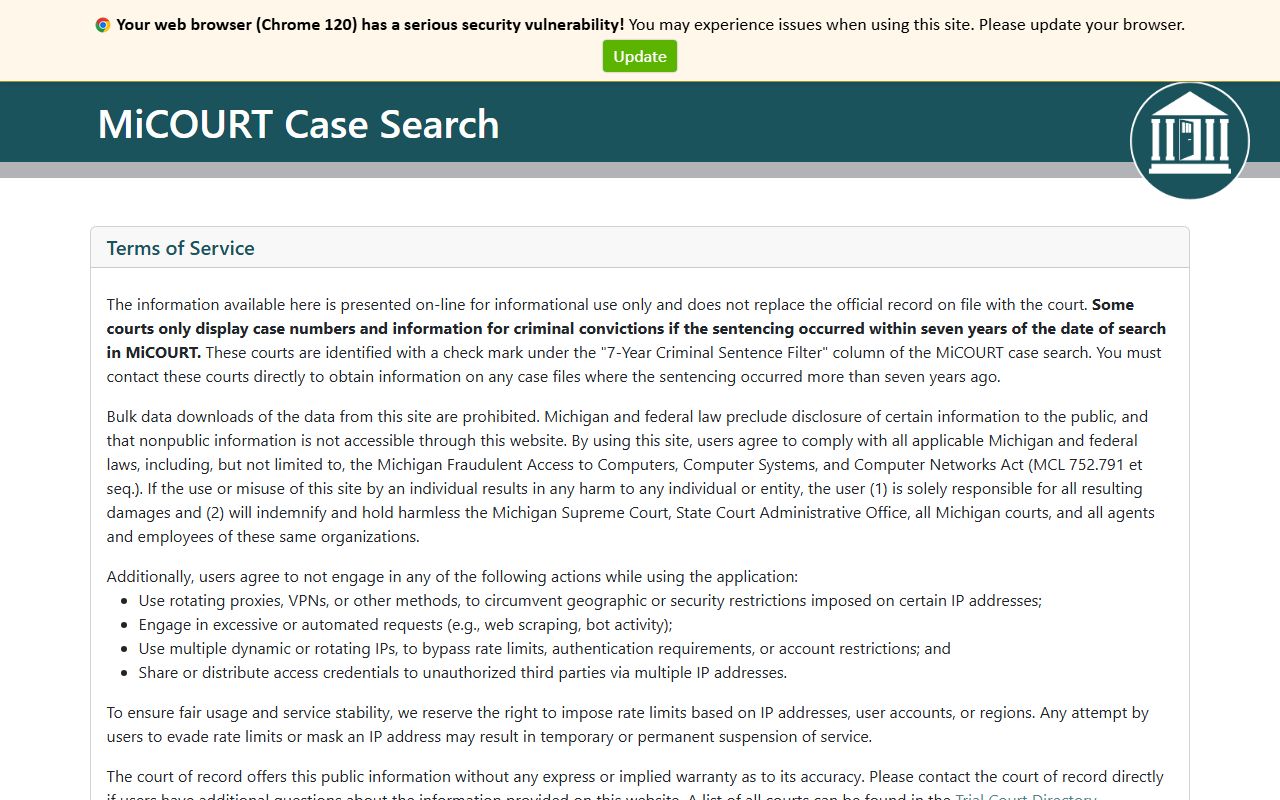
That portal is the statewide starting point, while the local court pages remain important for clerk contacts, court roles, and case-specific routing.
| MiCOURT Field | Type | Use for Presque Isle County |
|---|---|---|
| Court or court location | Dropdown or search selection | Select the Presque Isle, 89th District, or 53rd Circuit option where available. |
| Case type | Dropdown or tab | Choose criminal or traffic for most arrest-related cases. |
| Party name | Text | Use the defendant name when the case number is not known. |
| Case number | Text | Best search key if it appears on a notice, bond paper, or court receipt. |
| Date range | Date fields | Use filing or hearing dates when a name search is too broad. |
| Search or clear | Button | Submit the lookup or reset the form for a new court record search. |
Presque Isle Charging Documents
Charging documents explain why the court record exists. They are not the same as the arrest report. An arrest report describes what law enforcement says happened. A charging paper tells the court what offense is being prosecuted. In Presque Isle County, the prosecutor's charging decision appears first in District Court for misdemeanors and felony complaints. For a felony that moves forward, Circuit Court receives the formal felony case after bindover, waiver, or other transfer step.
| Document | Who Uses It | Where It Fits | Plain Meaning |
|---|---|---|---|
| Complaint | Prosecutor or court process based on law-enforcement facts | Common first charging paper in District Court | Starts the criminal case and states the charge being alleged. |
| Information | Prosecutor | Formal felony filing after bindover or waiver | Sets out the felony charge for Circuit Court proceedings. |
| Indictment | Grand jury process | Less common in routine county criminal cases | Charges a crime through a grand jury path instead of the usual complaint path. |
Presque Isle Charge Status
Charge status can change after the first court record appears. A case may begin with one charge and later show a reduced count, an amended charge, a dismissal, or a plea to a different offense. A jail booking entry may still reflect the arrest allegation, while the court file reflects the prosecutor's filed charge and the judge's orders. For that reason, use court records after an arrest to verify the legal status of each count, not just the words used at booking.
| Status | What It Means | Why It Matters |
|---|---|---|
| Pending | The charge has not reached final disposition. | Future hearings, bond terms, or plea discussions may still be active. |
| Amended | The prosecutor or court changed the charge wording or count. | The original arrest allegation may no longer match the active court charge. |
| Reduced | The charge was lowered to a lesser offense. | Penalty range, court level, and record meaning may change. |
| Dismissed | The count ended without a conviction on that charge. | A dismissal is not the same as a guilty finding. |
| Convicted | The defendant was found guilty or entered a guilty or no-contest plea. | The record now reflects an adjudicated outcome, not just an allegation. |
| Disposed | The court has entered a final outcome for the charge or case. | Look at the disposition details before drawing a conclusion. |
Bond After Presque Isle Arrest
Bond usually begins in District Court after a Presque Isle County jail arrest. The 89th District Court states that it arraigns defendants, sets and accepts bond, and handles early felony matters. Bond is the court's method for deciding whether a person can be released while the case is pending and what conditions must be followed. It can include cash, surety, personal recognizance, no-contact terms, testing rules, travel limits, or other conditions. If a felony is later bound over to Circuit Court, later bond changes may be handled in that court.
The jail's local payment channel is narrow. The sheriff jail information page says the lobby kiosk accepts cash or credit cards for deposit or inmate bond. A caller should still confirm the bond amount, bond type, accepted payment method, and any hold before traveling. A detainer, probation hold, parole hold, federal hold, ICE detainer, or another county warrant can keep a person in custody even when local bond is posted.
| Bond Type | How It Works | Local Check |
|---|---|---|
| Cash bond | Money is paid as ordered by the court. | Confirm whether payment goes through the court or jail kiosk. |
| Surety bond | A surety arrangement may post bond where allowed. | No official county bonding-company list was found. |
| PR bond | Release is based on a promise to appear and obey conditions. | Review all conditions before leaving custody. |
| No-bond hold | Release is blocked unless the court changes the order. | Ask whether another hold or warrant is active. |
Warrants and Court Records
No official Presque Isle County public active-warrant database was located on the sheriff or county pages checked. Warrant research should use official fallback channels: the sheriff's office, District Court, Circuit Court, and MiCOURT or the court-specific search links. A bench warrant may appear in an existing case after failure to appear or failure to comply. An arrest warrant may be tied to a new complaint. A search warrant is different because it authorizes a search and may not be public while active.
If a person is arrested on a Presque Isle County warrant, the jail booking may be followed by arraignment or a hearing in District Court. If the warrant came from another county, Presque Isle County may hold the person for transfer or for the other jurisdiction to act. Local bond may not solve an out-of-county warrant, probation hold, parole hold, federal hold, or immigration detainer. Court records after a jail arrest should be checked for warrant events and bond conditions before assuming release is available.
Charges and Convictions
A charge is an accusation filed in court. A conviction is a final guilty outcome by plea, verdict, or other lawful adjudication. This difference matters when reading Presque Isle County court records after an arrest because an online case may show several counts, but only some may be pending, dismissed, reduced, or proven. Treat every charge line as a status-specific record, not as proof that the person committed the offense.
| Point | Charge | Conviction |
|---|---|---|
| Stage | Filed accusation after prosecutor review | Final guilty outcome by plea or verdict |
| Proof level | Supported enough to proceed in court | Resolved under the criminal proof standard |
| Record meaning | May be pending, amended, reduced, or dismissed | Shows legal responsibility for that offense |
| Where to verify | Complaint, docket, bond order, hearing entries | Judgment, sentence, disposition, payment orders |
Sealed or Expunged Records
Some court records after a jail arrest may not be public. Juvenile cases, sealed files, certain dismissed matters, victim-protected information, and active investigative material may be restricted. Michigan public-record access also works alongside court rules and exemptions. The Michigan Freedom of Information Act can be used for public records held by public bodies, but it does not make every court or law-enforcement record open in full.
| Point | Sealed | Expunged or Set Aside |
|---|---|---|
| Public view | Hidden from ordinary public access by court order or rule. | Treated under Michigan set-aside law so public access is limited. |
| Record holder | The court or agency may still retain the file. | Records may remain available to limited justice agencies where law allows. |
| Common reason | Juvenile status, protected facts, court order, or nonpublic case type. | Eligible conviction or arrest outcome handled through clean-slate or court process. |
| Practical effect | A search may return no public case or only limited docket text. | Public case-search results may change after the order is processed. |
Restricted Presque Isle Records
Missing online results do not always mean no arrest happened. A case may be too new for MiCOURT, filed under a name variant, held in a court-specific system, sealed, nonpublic, or routed to another jurisdiction. The court pages note that official printed documents control over informational website text. For a fresh arrest, confirm custody first through Presque Isle County Jail, then ask the 89th District Court whether a complaint, arraignment, bond entry, or hearing has been filed.
State and federal systems should be used only when the custody type fits. The Michigan Department of Corrections OTIS locator is for prisoners, parolees, probationers, absconders, escapees, and recently discharged MDOC-supervised people. It is not the place to search for a new county jail booking. The BOP inmate locator is for federal sentenced custody, while ICE ODLS is for immigration detention. Those systems do not replace Presque Isle County court records after a local jail arrest.
Important: Court, jail, and search records may be incomplete or delayed, and consumer uses require legally compliant sources.